Table of Contents
Inferior Oblique Anterior and Nasal Transposition
The inferior oblique anterior and nasal transposition (ANT) is a strabismus procedure first described by David R. Stager Sr. and colleagues in their landmark 2003 publication in the Journal of AAPOS. Stager et al., 2003 The procedure involves detaching the inferior oblique (IO) muscle from its insertion and repositioning it both anteriorly and nasally relative to the inferior rectus (IR) muscle insertion, thereby converting the IO from an extorter and elevator into an intorter and tonic depressor.
Expected Effect
- Reduction of over-elevation in adduction
- some have restriction to elevation in adduction
- Reduction of XT in upgaze
- Improved head tilt
- Intorsion
- 18 degrees average intorsion effect Saxena et al., 2017
Surgical Technique
The IO muscle is disinserted and reattached at a new position typically 2 mm nasal and 2 mm posterior to the nasal border of the IR muscle insertion. Stager et al., 2003 This placement is critical — by moving the IO's effective insertion nasal to the IR, the muscle's vector of action is fundamentally altered. The procedure differs from standard anterior transposition (ATIO), which places the IO at or near the temporal border of the IR insertion. Stager et al. recommended the use of Mersilene (permanent) sutures rather than absorbable suture materials to prevent postoperative retraction of muscle fibers.
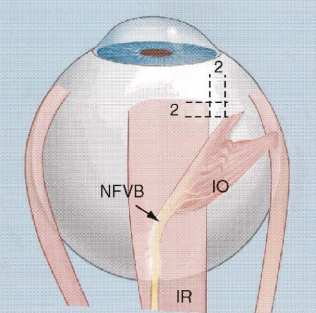
Stager et al., 2003
Indications
The procedure is particularly useful for:
- Superior oblique (SO) palsy — especially severe, recurrent, or congenital cases with significant excyclotorsion and abnormal head posture Stager et al., 2003 Saxena et al., 2017
- Absent SO tendons — including patients with craniosynostosis Hussein, Stager et al., 2007
- Antielevation syndrome (AES) — as a secondary procedure after prior IO anterior transposition Stager et al., 2003*
- Duane Syndrome with upshoot (though downshoot may worsen) Stager et al., 2003
- Dissociated vertical deviation (DVD) with IO overaction Fard, 2010
Stager et al. (2003) — Original Series and Outcomes
In the original series by Stager, Beauchamp, Wright, Felius, and Stager, 20 patients with IO overaction, SO palsy, absent SO muscles, AES, or Duane syndrome underwent ANT. Stager et al., 2003 Key findings included:
- Large improvements in ocular alignment, extorsion, and head posture in most patients
- The procedure effectively converted the IO into an intorter and depressor
- One poor result occurred in a patient with Y-pattern exotropia who underwent an extreme degree of ANT (4 mm nasal and 3 mm anterior to the nasal border of the IR insertion), developing comitant exotropia — leading to the caution that extreme ANT may induce exotropia in primary position
- In Duane syndrome, ANT corrected upshoot but downshoot could worsen
- Mersilene permanent sutures were recommended to avoid postoperative retraction of muscle fibers
Stager et al. (2007) — Absent SO Tendons
In a subsequent study, Hussein, Stager, Beauchamp, Stager, and Felius reported on 9 children (2 unilateral, 7 bilateral) with absent SO tendons who underwent ANT. Hussein, Stager et al., 2007
- Both unilateral cases achieved orthotropia with no abnormal head posture
- In bilateral cases, vertical deviation in adduction and exotropia in upgaze had largely cleared, though some residual vertical deviation in side gaze (3 patients) and V-pattern esotropia in downgaze (2 patients) persisted
- The procedure was most effective in unilateral SO tendon absence
- It is likely to benefit patients with severe congenital fourth nerve palsy in which standard IO weakening procedures have been ineffective
Subsequent Validation
Other groups have confirmed the efficacy of ANT:
Saxena et al. (2017) reported on 12 patients with SO palsy, demonstrating: Saxena et al., 2017
- Correction of median hypertropia from 21.5Δ to 4.5Δ (P = 0.002)
- Near-complete elimination of fundus extorsion (19.2° → 0.58°, P 2 mm nasal) may induce exotropia in primary position Stager et al., 2003
- Hypotropia can occur postoperatively (2–5 PD) Fard, 2010
- In Duane syndrome, downshoot may worsen despite correction of upshoot Stager et al., 2003
- Permanent sutures are recommended to maintain the transposition position Stager et al., 2003
References
- Stager DR, Beauchamp GR, Wright WW, Felius J, Stager D. Anterior and Nasal Transposition of the Inferior Oblique Muscles. J AAPOS. 2003;7(3):167-173. PubMed
- Saxena R, Sharma M, Singh D, Sharma P. Anterior and Nasal Transposition of Inferior Oblique Muscle in Cases of Superior Oblique Palsy. J AAPOS. 2017;21(4):282-285. PubMed
- Hussein MA, Stager DR, Beauchamp GR, Stager DR, Felius J. Anterior and Nasal Transposition of the Inferior Oblique Muscles in Patients With Missing Superior Oblique Tendons. J AAPOS. 2007;11(1):29-33. PubMed
- Fard MA. Anterior and Nasal Transposition of the Inferior Oblique Muscle for Dissociated Vertical Deviation Associated With Inferior Oblique Muscle Overaction. J AAPOS. 2010;14(1):35-38. PubMed
- Farid MF. Anterior Transposition vs Anterior and Nasal Transposition of Inferior Oblique Muscle in Treatment of Dissociated Vertical Deviation Associated With Inferior Oblique Overaction. Eye (Lond). 2016;30(4):522-528. PubMed